Tracking gets messy during the game
Re-buys happen mid-conversation, chips move fast, and paper notes drift out of date.
A mobile-first poker session tracker for casual home games.
Track buy-ins, settle the math, and share the final results with the group.
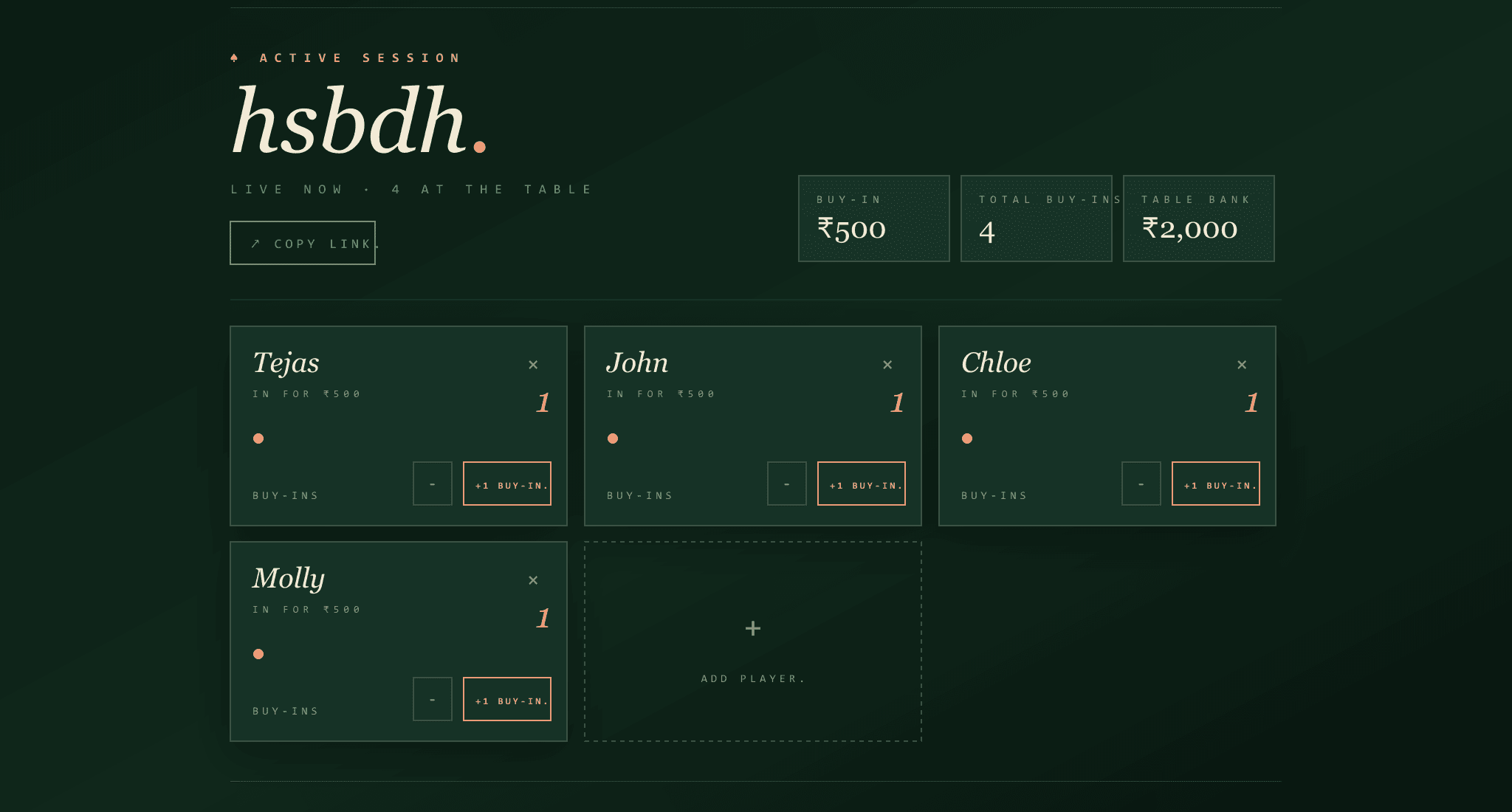
Tracking, payouts, and group sharing usually happen across notes, calculators, and WhatsApp.
Re-buys happen mid-conversation, chips move fast, and paper notes drift out of date.
Hosts are left turning cash-outs into balances while everyone is ready to leave.
Final numbers usually end up as screenshots, partial notes, or a long chat explanation.
Designed for the person managing the table, tracking buy-ins, and settling the night.
A lightweight session flow designed for live games, fast updates, and clear final outcomes.
Four decisions that made the product simpler, more usable, and more native to poker groups.
Start with a host, buy-in value, and players. No account wall before the game.
The product earns trust when it turns noisy table activity into clear balances.
The final artifact is built for the chat where the group already coordinates.
Warm felt, clean ledgers, and high-contrast actions make the app feel game-night native.
A simple product health framework across activation, setup depth, core value, distribution, and retention.
Shows whether hosts can start a game without friction.
Measures whether the app supports real group usage.
Shows whether users reach the main payoff moment.
Measures whether results are useful enough to share.
Shows whether hosts come back for future games.
The MVP stays focused on solving one workflow well.
Reduced setup friction for casual games, with identity deferred until there is repeat value.
Cash games were the clearest wedge because settlement pain is immediate and frequent.
Kept attention on the table workflow instead of adding another place to maintain presence.
The next layer is about memory, smarter settlements, and repeat group behavior.
Reliable buy-ins, cash-outs, balances, and a shareable end state.
Help repeat hosts restart the same group without rebuilding the table.
Move from a single-night tool into a durable group ledger.